
Canadian Communities

“That this House recognize that the Québécois form a nation within a united Canada.”
-Canada’s parliamentary Québécois nation motion, 2007
Canada is not a nation-state. It is a country governed by a single state which is populated by several nations and numerous communities, none of which constitute a majority. The Canadian state has formally recognized several of these nations and communities. It, through legislation, customs, and court decisions, treats them differently. This creates a complex framework of group-based policies which drive significant internal tensions.
As individuals, men and women are quite helpless. Even in the most primitive eras they relied on bands of a few dozen to survive in the wilds of the untamed world. Left alone, a man would succumb to the attacks of animals while he rested or the varieties of weather. As societies became more complex, men became even more dependent upon the organization of his fellows. Artisans required food while farmers required their crafts, and both depended upon soldiers for their security, who in turned required the products of both to sustain their campaigns.
Whereas the most primitive societies were purely personalized, with relationships exclusively between individuals, more advanced societies by necessity involve relationships between groups. The nature of those groups, their organization, and their interactions with each other varies across time and place. However, their form and function typically develop around class, ethnicity, institution, language, and region.
Canadian state and society are, like those of all countries, organized along several lines. The federal parliament is elected on a joint regional and party basis, with adult citizens equal in their ability to cast votes in their federal electoral districts1 for candidates provided by the federal political parties. Similarly, adult citizens cast votes in provincial electoral districts for candidates provided by the provincial political parties. This is standard across Western states, and why they consider themselves to be federal democracies.
This model of government came under increasing stress in the late 19th and early 20th centuries. The small formal political class of a few hundred federal and provincial politicians had long struggled to manage even a largely scattered rural population. As the population urbanized and the economy grew increasingly sophisticated, state administration required the growth of both federal and provincial bureaucracies. The bureaucrats who comprised those bureaucracies were able to administer the Canadian state and shape Canadian society under the guidance of elected officials, but soon transformed into a new class. This bureaucratic class endured across premierships, and possessed its own culture and interests independent of the general population. Thus in addition to the abuses which invariably emerge even from the noblest of classes and institutions as the result of their size, there was a genuine clash of interests between the public and the bureaucracy.
To respond to these abuses and the clash of interests, Canada, like most other Western states, created a rights framework. In theory, the rights framework was supposed to protect citizens and communities from an overbearing bureaucracy and elected politicians. In practice, it transferred a great deal of power to the judiciary, and through them to both communities and the human rights class.
While Canada began creating its rights framework decades earlier, the framework took its modern form with the enactment of the Charter of Rights and Freedoms, part of the 1982 Constitution. The Charter enumerated considerably more rights than the United States’ Bill of Rights. As a result, courts and legal activist groups exerted a greater range of review in Canada than their counterparts could in the United States. This eased the process by which they could reorganize state and society.
Courts, legal activist groups, and human rights tribunals have little ability to implement programs. They rely upon fines, lawsuits, and judgements to create a regulatory and legal environment which forces business and bureaucratic compliance with the prevailing legal fashions. Companies and bureaucracies respond to that environment by tasking their human resources departments to implement hiring and training programs which attempt to comply with present and future legal and regulatory fashions. Those programs, tailored to different bodies of workers, add to a shallow shared culture in the process of legal and regulatory compliance.
Thus the courts, legal activist groups, and human rights tribunals - usually staffed with a mix of ethnic minority activists, sexual minorities, feminists, and environmentalists - shape Canadian culture through regulation independently of or sometimes even antagonistically with the usual culture-producing classes (artists, churchmen, musicians, authors, film directors, etc). Additionally, they shape both business and bureaucratic structures to be more favorable to the most privileged communities, and encourage exclusion of communities unrepresented in the human rights framework such as Whites.
At the same time that the rights framework was being formed, the Canadian government began funding minority organizations. Ethnic minorities and immigrants could receive regional and party representation through elections, but lacked the ability to interface with the real sources of power in the Canadian system. Funding for ethnic community and legal activist groups provided them that ability. Those groups lobbied elected officials, filed lawsuits in the courts against organizations to align them, and worked with government institutions to guide them.
Federally-funded minority organizations and the human rights class were further strengthened through their alliance with ESG advocates. ESG - Environmental, Social, and Governance - originated in the 1980s, but became more popular in the 21st century. Activist shareholders, particularly politically-controlled government pension funds, used their shares in companies to influence their policies in hiring, supply chains, civic donations, and more. Rather than encouraging those companies to act in the interest of all shareholders, they instead promoted favored communities and policies, often to the detriment of not only other shareholders but also employees as well. For instance, companies were pushed to hire corporate board members not on the basis of their past performance, but instead on their First Nations status, sex, and racialized background.
Canada’s communities attained or were granted different levels of power as the result of the state’s communities and nationalities policies. Their interactions and their jockeying for status - as well as the reactions of others to it - greatly shape Canadian politics. This is particularly important in three of the largest provinces: British Columbia, Ontario, and Quebec.
Canada divides her population into three groups: racialized, non-racialized, and aboriginal. The aboriginal population is comprised of the First Nations (Amerindians and Dine), Inuit, and Metis (a mixed European-Amerindian population). The racialized population is comprised of the non-aboriginal non-White population. It is predominately Chinese, Filipino, Punjabi, Pakistani, Vietnamese, Tamil, Iranian, Jamaican, and Arab. The non-racialized population is the White population, divided by language into the English-Canadians and the French-Canadians. The latter is further divided into the Quebecois, a federally recognized nationality, and the various French-speaking populations of other provinces.
Aboriginal Communities
Canada’s aboriginal communities are those whose presence in Canada antedates that of European settlers. Their customary forms of governance and land claims are recognized to varying degrees by federal and provincial governments.
First Nations
Canada’s First Nations are the Amerindian and Dine. Like the Metis and the Inuit, they are considered to be indigenous by the government, but unlike the Metis and Inuit they are subject to the Indian Act. The Indian Act regulates who can consider themselves a member of the First Nations, recognizes their corporate representation in the form of bands, and lays out how band governments operate.
The First Nations have four forms of political representation. The first is through the electoral process, where they cast votes for candidates selected by parties for provincial and federal offices. The second is through their 634 band governments, which vary from hereditary chiefdoms to democracies. The third is through the Assembly of First Nations, whose federal leaders are elected by the band leadership. The AFN is largely funded by the federal government, thus its priorities are typically dictated by Liberal Party officials. The fourth is through the First Nations faction in the “Court Party” - typically federally or bar funded legal activist groups which utilize the courts to impose their will upon the Canadian state.
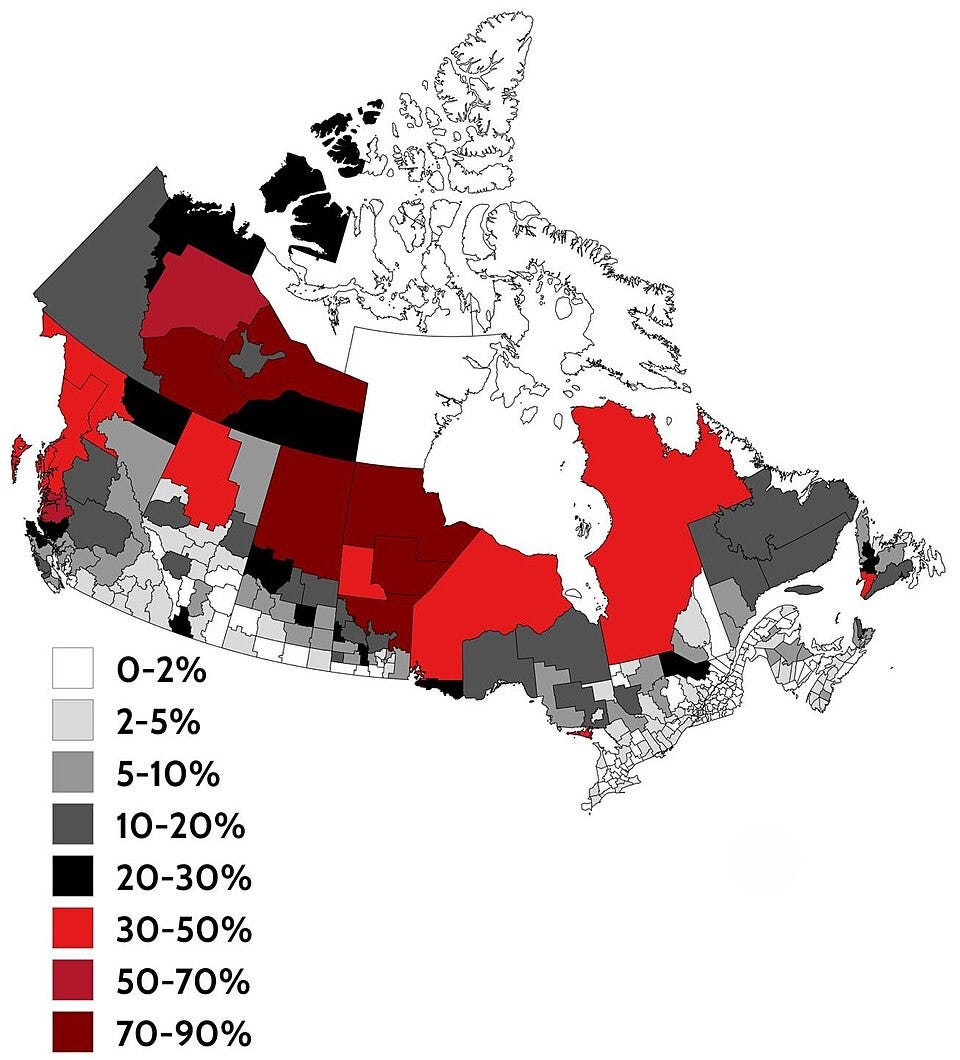
Share of population with First Nations status, 2021
There are approximately 1.05 million First Nations members in Canada, comprising around 3% of Canada’s population. They are demographically dominant in a belt stretching from northern British Columbia through central Quebec. They have a privileged role in Canadian politics, with a right to consultation across most of the country and land claims upon much of the east and British Columbia. They have a privileged role in the legal system as well. First Nations members have received lesser sentences for crimes since the 1995 revision of Canada’s criminal code. That revision was affirmed by the Supreme Court’s 1999 decision R v Gladue and subsequent cases.
Inuit
There are around 71,000 Inuit in Canada. They are concentrated in the far north, and are an outright majority of the population of the population in the territory of Nunavut. Nunavut was intentionally formed out of the Northwest Territories to be an Inuit ethnic territory. The Inuit are like the First Nations and Metis considered to be indigenous to Canada, but they like the Metis were never regulated by the Indian Act. Inuit status is as such not defined by the federal government, but instead by self-identification and community approval.
The Inuit receive federal representation through both the Nunavut Member of Parliament and the Inuit Tapiriit Kanatami. The ITK serves as an advisory group for the federal government on Inuit issues. Its activities are supplemented by the Inuit Circumpolar Council, which contains Canadian members and is occasionally chaired by Canadian Inuit in rotation.
Metis
The Metis are the descendants of European merchants and Amerindian women who were engaged in the fur trade in the 18th and 19th centuries. They formed their own communities in the Prairies separate from both the Amerindian tribes and British settlers. The Metis, despite their mixed European and Amerindian ancestry, are legally defined as an indigenous people in Canada. Their status, like that of the Inuit, was never defined by the Indian Act, but instead became defined by the Supreme Court. In R v. Powley, the Supreme Court determined that one can be considered a Metis if they self-identify as Metis, are a descendant of a member of a Metis community, and are accepted by a Metis community.
Canada’s census suggests that the numbers of Metis have grown rapidly over the last thirty years. Most of the growth is fraudulent. The social and financial benefits of Metis ancestry, as well as its ease to claim (unlike First Nations status), drove its increase among the non-racialized (White) population in commensuration with the government’s increasingly burdensome community policies. The number of actual Metis is likely around 230,000.
While the Metis have a number of federal-level organizations, they have little influence. Their primary representation is at the provincial level, where Metis organizations have long-standing relationships with provincial governments in the Prairies. Their moral and legal authority are quite weak relative to that of the First Nations and recent immigrant groups.
Racialized Communities
The Canadian government considers race to be a social construct, and thus an illegitimate source of authority or reason for representation. However, the state also sees racism as a great evil, so communities which may be or have been targeted by it are eligible for special protection, representation, funding, and privileges as racialized communities. Aboriginal populations are not considered racialized.
Sikhs and Khalistanis
About one million Sikhs, predominately Punjabi speakers, live in Canada. They amount to perhaps 2.5% of Canada’s population. The population has been doubling every 10-15 years since the 1960s, overwhelmingly due to immigration. The current Sikh population is about three-quarter immigrants, one quarter native-born.
Canada’s Sikhs maintain extensive ties to their relatives in India, and are active in supporting the Khalistan movement. The Khalistan movement aims at creating an independent Sikh state in the Punjab and sometimes neighboring areas. It has held seven referendums on independence in Canada, each attracting tens of thousands of voters. It has also engaged in terrorism, primarily but not exclusively aimed at the Indian government.
Sikhs are organized primarily around their religious congregations, but are organized at a countrywide level by the World Sikh Organization of Canada. The WSO utilizes the courts much as other communities do, through filing suits and intervening in existing litigation to further community interests outside of the democratic process. As an active and organized community, the Sikhs have been able to exert a great deal of influence on Canadian government policy through their own, organically funded organizations as well as through the electoral process. This has caused a number of diplomatic incidents with India, and cooled relations between Canada and India. Eighteen of Canada’s three hundred and thirty eight MPs are Sikhs, 5.3% of the total.
Hindus
There are approximately 1.2 million Hindus in Canada, comprising around 2.9% of the population. A majority of Canada’s Hindus are immigrants. Unlike the Sikhs, who overwhelmingly speak a single language, Punjabi, Hindus speak a number of different languages. The fragmentation of Canada’s Hindus into Hindi, Tamil, Gujarati, Malayalam, Telugu, Bengali, and other linguistic communities thus prevents the formation of a powerful Hindu community bloc in Canada. A number of countrywide Hindu organizations exist, but none have much sway with either society or the government. There are only four Hindu federal MPs, and Hindu representation in the provinces and municipalities is even weaker.
Due to weak community structures and a religion which emphasizes orthopraxy over orthodoxy, Hindus in Canada tend to seek representation in the extant political parties and through their regional governments. Recently, a number of attacks from Sikhs over the Khalistan issue have driven an increase in Hindu counter-organization.
Muslims
About two million Muslims reside in Canada, amounting to 4.9% of the population. The Muslim community is fragmented by sect, language, and ethnicity. About a third of Canada’s Muslims are Arabs, an eighth are Iranian, two-fifths are from South Asia (India, Pakistan, Bangladesh), an eighth are African (mostly Somali). While this prevents effective countrywide organization, local organization based around mosques is strong enough to influence the federal government on certain issues - notably Canada’s recognition of Palestine. They are most heavily concentrated around Toronto and Montreal, and have been politically active across the country in opposition to Israel.
The Canadian government, similar to most Western governments, attempts to co-opt the Muslim communities of Canada for its own purposes. Groups like the Canadian Council of Muslim Women are largely funded by the federal government. They attempt to incorporate Muslims into a broader left-liberal coalition as an identity group rather than as a community of believers. The former can be and has been manipulated by left or liberal governments into changing their views on the social issues which animate Western elites while the latter is far more resistant.
Blacks
There are about 1.8 million people with sub-Saharan African ancestry in Canada. They amount to 4.4% of the population. About 830,000 of them have Caribbean heritage, while the remaining 970,000 derive directly from Africa. Roughly a third of Canada’s black population is Francophone and comes from Haiti or France’s former African colonies.
Unlike the United States, Canada does not have a history of black slavery. However, the United States’ tremendous cultural influence upon Canada, combined with the power of human rights commissions and employment equity laws, has granted Blacks a privileged position in the English-speaking parts of Canada. Like First Nations members, Blacks convicted of crimes outside of Quebec are eligible for a kind of pre-sentencing review which typically recommends a lesser sentence. Quebec, whose political culture values civic equality in opposition to Canada’s constitutional protections of positive discrimination, rejected those pre-sentencing reviews.
Federally funded organizations such as Federation of Black Canadians and Black Lives Matter Canada exist to provide federal-level community representation for the black population, but it largely serves the interests of predominately upper class Jamaican and Haitian heritage Canadians. The masses are poorly organized, and have little to no grassroots organization outside of implicit social groups in certain neighborhoods in Montreal and Toronto.
Currently, eight members of parliament are Black. Six have Caribbean heritage, two are Conservatives, and six are Liberals.
Chinese

Concentration of Chinese-Canadians. Darkest red is >20%
About 1.8 million Chinese live in Canada, amounting to 4.4% of the population. Approximately three-quarters are foreign born, and one quarter are native to Canada. Half of Canada’s Chinese population speaks Mandarin, about a third speak Cantonese, and the remainder speak other Chinese dialects or only English. An eighth of Canada’s Chinese originate from Hong Kong, a twenty-fifth originate from Taiwan, half originate from China proper, and seven percent originate from other countries (mostly Vietnam and the Philippines).
While present across the country, the Chinese are most densely concentrated in British Columbia, where they amount to a tenth of the population. British Columbia’s primary metropolitan area, Vancouver, is a fifth Chinese. There is no unified Chinese community in Canada, and even the people in Chinese-language social spheres are deeply divided on issues in both China and Canada. The CPC’s United Front is active in Canada, and has cultivated numerous prominent political figures, predominately but not exclusively in Toronto and Vancouver.
Chinese-Canadians, like most racialized communities, have multiple forms of representation. There are currently nine Chinese MPs in the federal parliament, most of them representing heavily Chinese areas. The Canada-China Business Council, Canadian Alliance of Chinese Associations, and other voluntary groups organize for the benefit of immigrant communities and business interests. Federally-funded groups with little community support, such as Chinese-Canadian National Councils, work to align Chinese with the Liberal Party and left-liberal ideology.
Non-Racialized Communities
As racism is understood by the Canadian government to be an exclusively European phenomenon, Whites cannot be a racialized community. This understanding denies the White majority of the population access to anti-discrimination laws, human rights commissions, and federally funded legal activist groups - all of which are critical in ensuring that a group’s interests are represented in the bureaucracy, business, and the labor force.
French-Canadian
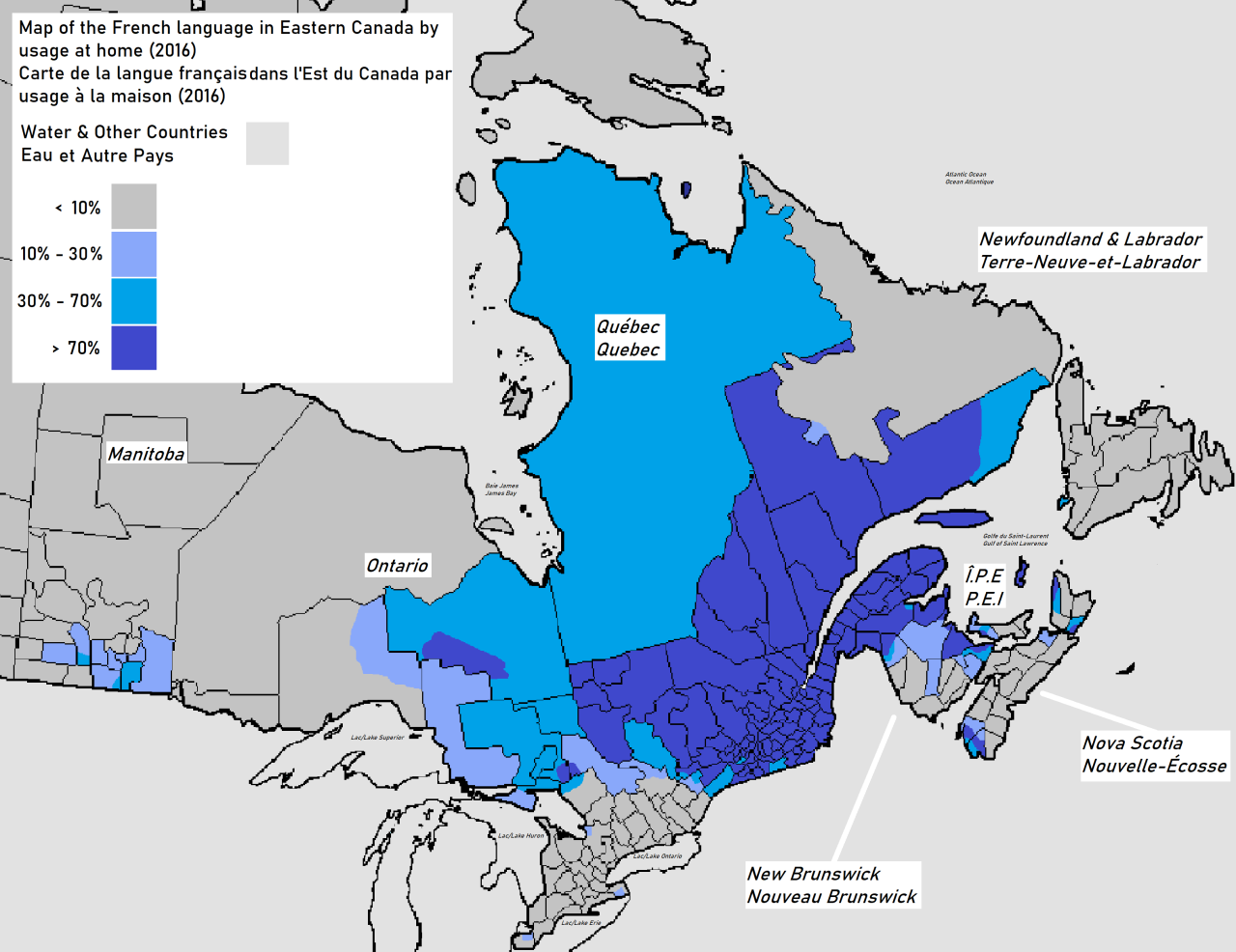
There are 6.8 million non-racialized (White) French-speakers in Canada. Of those, 6 million are Quebecois and 800,000 are non-Quebecois French-Canadians. The Quebecois overwhelmingly derive from a small group of 17th century French settlers, but assimilated some English, Irish, Jews, Poles, and Germans over the course of the 19th and 20th centuries. They have been formally recognized as a nation within Canada by the federal government. Non-Quebecois French-Canadians, predominately in the bilingual province of New Brunswick and in the English-dominated province of Ontario, are almost exclusively of French origin.
French-Canadian representation differs in and out of Quebec. Outside of Quebec, French-Canadians have access to the Commissioner of Official Languages, who effectively acts as a representative of French minority communities, as well as English-French bilingual bureaucrats who jealously guard their French language prerogatives within the federal bureaucracy provided to them by the Official Languages Act. In Quebec, the electoral parties compete heavily for the support of the Quebecois population. The population, divided primarily on sovereigntism and federalism rather than conservatism and liberalism, receives electoral representation which is far superior to that of the rest of Canada, as seen most clearly in the extensive federal subsidies to Quebec.
Quebecois sovereigntist parties argue that they represent the Quebecois nation within Canada, but define that nation in purely civic terms. Francophones in neighboring Ontario and New Brunswick are not considered to be Quebecois and are explicitly rejected by the federal Quebecois party, Bloc Quebecois. However, Haitians, Moroccans, Irish, and others who learn French and participate in Quebecois society are considered fully Quebecois.
The English-French divide has long been the defining feature of Canadian politics, but may not do so for the indefinite future. Quebec’s preference for culturally and linguistically based assimilation is more exclusive than English-Canada’s belief in a civic membership based on an ill-defined set of values. The result is that demographically the Francophone and particularly Quebecois population have been steadily declining as a share of the population for decades. The younger generations, heavily influenced by English-language internet culture, are less committed to the unique society than either their parents or grandparents.
While the pro-separatist Parti Quebecois may prevail in the October 2026 provincial election, it is unlikely that a new sovereignty referendum will succeed without the covert intervention of the United States.
Americans
The 17 million English-speaking Whites and 100,000 Eurasians in Canada are limited to the political representation provided by their electoral district and party. Such representation was hardly sufficient by the middle of the 20th century, and is even less sufficient today. The unions, churches, and voluntary associations which provided their ancestors organized representation independent of the electoral process have all severely decayed in both appeal and prestige over the last half-century.
As the Canadian government refuses to recognize these 17.1 million people as a community, they should be considered Americans on the grounds of either values and ancestry. They speak English, derive a large part of their ancestry from Americans2, primarily interact with American culture, and define their beliefs through American frameworks. Like Americans, their culture-producing classes migrate to New York or Los Angeles to practice their arts. Their politicians, left and right, have looked south for guidance and inspiration for a century.
While the largest demographic group in Canada, accounting for 41.5% of the population, Americans are both poorly organized and deeply divided. The older generations - particularly those who were born before 1980 - remain loyal to Canada and antagonistic to the United States. The younger generations are far more open to America, and animate annexationist sentiment, particularly in the western provinces of British Columbia, Alberta, and Saskatchewan.
Nonetheless, with little leadership and funding, annexationist sentiment remains limited to a sizeable minority. The American passionaries in Canada - those who form activist groups, write polemics, do political research, and more - largely trap themselves in obsolete paradigms which prevent them from addressing Canada’s real structural issues. Those obsolete paradigms and the lack of community organizations render the Americans unable to even identify and much less respond to attacks upon their interests. The Americans of Alberta are partially an exception to this due to the hard work of academics at the University of Calgary and the influence of the oil industry.
Canada’s Liberal Party, the natural ruling party of Canada, has been increasingly squeezing them out of federal, provincial, cultural, business, and bureaucratic leadership; further reducing their potential. Without the intervention of the United States, they are unlikely to ever achieve equal rights.
in Canada usually referred to as a riding
the main waves of American migration were the Loyalists who fled to Canada after their defeat in the American Revolution, the large-scale New Englander settlement of Upper Canada in the first few decades of the 19th century, and the late 19th and early 20th century American settlement of Prairies as an extension of the Great Plains. Across all time periods Canadian-American intermarriage has been quite common.
Superb analysis of Canada's multi-tiered communtiy structure. The part about how ESG advocates basically weaponized shareholder power to bypass democratic process is spot on. Back in my consulting days, I watched boardrooms shift from profit maximization to identity scoreboards practically overnight once pension funds started flexing. What strikes me most is howthe Charter essentially transferred power from elected officials to the judiciary and HR departments, creating this parallel governance system that operates outside voter accountability.
The way you matter-of-factly refer to the Americans of Canada is hilarious; the situation up here is bleak and I really needed a laugh. Your analysis misses that the "Americans" do have elite representation, but the tragedy is that it is precisely these elites who are responsible for their problems. They went insane some time ago and decided to make the destruction of Canada their prime directive. Trudeau I & II, the most flamboyantly demented members of the judiciary - these are Old Stock Canadians, in many ways the rightful ruling elite of our country. Sad!
My parents were Dutch/Italian, they intentionally assimilated, fully, and I now have had the rug pulled out from under me because there is no such thing as a Canadian Identity anymore. Elbows Up!